How long does foreclosure take in Calgary? Months, not weeks. A Calgary foreclosure moves through a demand letter, a Statement of Claim, an Order Nisi and then a redemption period — commonly around six months for an ordinary, non-farm home. Court schedules vary and a defended claim runs longer, so no timeline is ever guaranteed.

A typical Calgary foreclosure moves through a demand letter, a Statement of Claim filed in the Court of King's Bench of Alberta, an Order Nisi, and then a redemption period — commonly around six months for an ordinary, non-farm home. Added together, the full process commonly runs somewhere in the range of 8 to 15+ months from the first missed payment to a confirmed sale.
Every file is different, though. Court schedules vary, a defended claim runs longer than an undefended one, and no timeline is ever guaranteed.
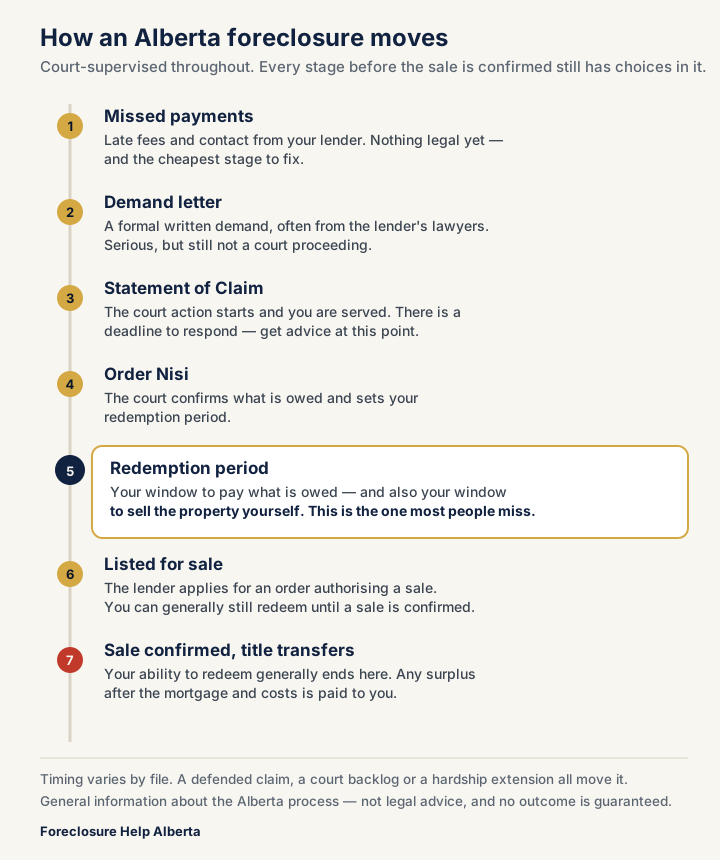
What makes this predictable at all is that Alberta uses a court-supervised judicial sale — a lender cannot simply sell your home. Every stage below is a stage where you still have real options, including selling on your own terms and protecting the equity you have left.
How long foreclosure takes in Calgary, stage by stage
| Stage | What happens | Roughly how long | What you can still do |
|---|---|---|---|
| 1. Missed payments | You fall behind. Lender contact begins — calls, letters, late fees. | From the first missed payment | Ask about an arrears arrangement, or start exploring a sale on your own timeline. |
| 2. Demand letter | A formal written demand, often through the lender's lawyer, warning that legal action follows. | A short window set by the lender | Pay the arrears, negotiate, refinance, or list before a claim is filed. |
| 3. Statement of Claim | The court action starts and you are formally served. | You are given a response window — ask a lawyer about the deadline that applies to you | Respond, get legal advice, negotiate, or continue toward a private sale. A claim does not end your options. |
| 4. Order Nisi | The court confirms default and sets your redemption period. | Depends on whether the claim is contested | Redeem, sell privately, or refinance. Your right to redeem holds until a sale is confirmed. |
| 5. Redemption period | Your window to pay what is owed and keep the home. | Commonly around six months for an ordinary home | Your biggest window. Redeem, sell on the open market, or arrange refinancing. |
| 6. Listing for sale | If the mortgage is not redeemed, the lender applies for an order authorising a sale. | Weeks to a few months | You can generally still redeem until the sale is confirmed — ask a lawyer where that line sits in your file. |
| 7. Sale confirmed, title vested | The court confirms the sale and title transfers. | Varies with the court schedule | Your ability to redeem generally ends here. If you are near this stage, get legal advice immediately. |
This is a general pattern, not a promise. A defended claim, a court backlog, a hardship extension or an early resolution can all move it in either direction, and nothing here is legal advice.
What shortens how long foreclosure takes
- The claim goes undefended — undefended matters commonly move faster through the early stages.
- There is little or no equity left in the property.
- The homeowner and lender agree on timing by consent.
- The property is already vacant.
What stretches it out in Calgary
- The homeowner defends the claim or asks the court for more time.
- There is meaningful equity — courts weigh that when setting a redemption period.
- Court scheduling backlogs.
- Active negotiation between the lawyers.
- Genuine hardship shown to the court.
None of that is automatic. The court decides case by case.
Who you are actually dealing with: Rob Vanovermeire
Rob Vanovermeire is Broker of Record at Coldwell Banker Mountain Central, a licensed Alberta real-estate brokerage. A foreclosure is not an ordinary sale and it does not run on a seller's timetable: the court sets the dates, the lender's costs keep accruing against your equity while they pass, and most of the decisions worth making have to be made before a sale is confirmed rather than after. Knowing which of those dates is the one that actually binds you is the difference between having options and being told what is happening.
For a Calgary homeowner that is concrete. Your file is heard at Calgary Courts Centre, 601 5 St SW — so the paperwork timeline you are working to is that one, not a general Alberta one and not an American one. It is the kind of detail that decides whether there is still time to market a home properly or only time to react. Where title is concerned: Land Titles South.
What he is brought in for is the part with money in it: what the home is realistically worth today, what a court-run sale would likely leave once costs come off it, and whether a properly marketed sale in the time available would do better than that. You get those numbers before you decide anything. Nothing is listed, no lender is contacted, and nobody is committed to selling — plenty of people use the figures to argue for keeping the house instead. Ask for a free, confidential assessment.
Where this happens if you are in Calgary
The law above is the same everywhere in Alberta. What changes with where you live is which courthouse your file goes to and which Land Titles office holds your title:
- Court: Calgary Courts Centre, 601 5 St SW
- Land Titles: Land Titles South
Neither of those changes your options. They change where the paperwork lands, which is worth knowing before a deadline rather than after one.
What homes around Calgary are actually worth
Equity is the whole question when you are behind. These are the most recent verified figures we have for the communities around Calgary, each with the month it was measured — not an estimate, and not a valuation of your home:
- Chestermere (population 22,163) — Detached homes were around $774,300, down about 4.3% year over year. As of June 2026.
- Strathmore (population 14,339) — Benchmark price around $437,700, up about 1.7% year over year — one of the more affordable communities in the Calgary region. As of February 2026.
A benchmark is not an appraisal. It tells you which direction the market moved, which is what decides whether waiting costs you money or buys you time.
Free help in Calgary
These are independent organisations. We are not connected to them and we are not paid to list them.
- Calgary Legal Guidance — 403-234-9266. free legal help for low-income Albertans — office hours Monday to Friday, 9am to 4pm; phone to ask about clinic times
- Court Assistance Program (KB Amicus). free 30-minute volunteer-lawyer consults for self-represented civil litigants, walk-in at the Calgary Courts Centre
- Basic Needs Fund — call 211. emergency funds for rent arrears and eviction prevention
- Legal Aid Alberta — 1-866-845-3425
- Money Mentors — 1-888-294-0076. Alberta non-profit credit counselling, and the Orderly Payment of Debts programme — an Alberta-only court-ordered consolidation option
- 211 Alberta — 211. connects you to local financial and housing supports
If a consumer proposal or bankruptcy might be part of your situation, speak to a Licensed Insolvency Trustee. They are the only people licensed to advise on it.
Questions people ask
The complete Calgary foreclosure guide: every stage, every option, in one place →